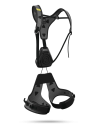
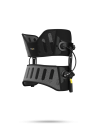
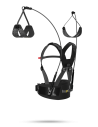
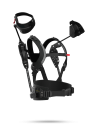
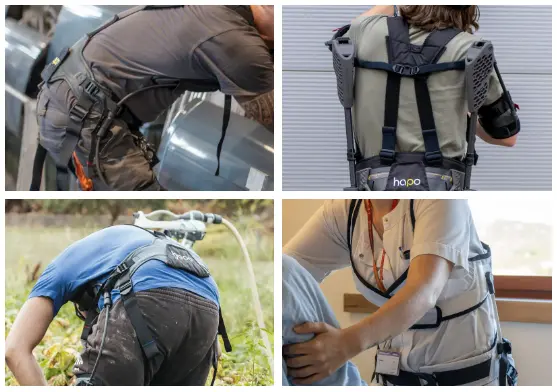
Handling exposes professionals to very different situations: lifting or placing objects, bending repeatedly, preparing orders, working in a crouched position, keeping arms in front of oneself, or reaching for items at height.
When these operations are repeated, they can create significant physical constraints.
A handling exoskeleton is a physical assistance device worn by the user and designed to support certain movements or postures. Depending on its design, it can particularly support the back, shoulders, arms, or neck.
Its goal is not to artificially increase the worker's maximum capabilities. Rather, it aims to reduce certain biomechanical constraints, limit fatigue associated with strenuous or repetitive tasks, and contribute to the prevention of body wear and tear at work.
The HAPO exoskeletons are non-motorized, also known as passive exoskeletons. Therefore, they do not require a battery to be recharged.
Depending on the devices, materials with adaptable elastic resistance mechanical properties allow for the storage and release of mechanical energy to assist a movement or maintain a posture.
This approach aims to reconcile:
The exoskeleton thus remains at the service of professional gestures: it accompanies the natural movement of the body without seeking to replace the operator.

The term "handling" covers very different realities. An order picker who retrieves products from the lower part of a shelf, an operator who handles parts in front of him, and a professional who regularly works with arms raised are not exposed to the same constraints.
It is precisely for this reason that there is no universal handling exoskeleton.
Repeated trunk flexions, working with the torso bent forward, or certain phases of handling can heavily strain the lumbar region.
Appropriate physical assistance can accompany the movement of the trunk and support the back during phases identified as demanding.
However, the objective must remain clear: a back exoskeleton does not allow for carrying more weight.
It does not change the limits to be respected in terms of handling and should never be used to make acceptable a work situation that should first be corrected.
Handling does not only involve the back. In a warehouse or workshop, certain operations involve, for example:
In these situations, assistance for the upper limbs may be relevant.
This is why the analysis should always start with the question: which part of the body is being used, by what movement, and for how long?
Some tasks alternate between standing, bending the torso, squatting, and working on the knees. In this context, mobility becomes an essential criterion. Assistance must be chosen based on the actual movements performed. A device suitable for prolonged bending is not necessarily the best fit for a highly dynamic activity with frequent posture changes.

The profession provides an initial context, but it is never enough to select a device. Two warehouse workers working in two different companies may have very different activities and physical constraints.
The selection must therefore be based on the work situation.
| Observed Situation | Mainly Solicited Area | Type of Assistance to Consider | Potentially Relevant Hapo Solution* |
| Repeated bending and straightening of the torso | Back | Support for bending and straightening | Hapo HD |
| Bent trunk, prolonged bending | Back / lumbar | Lumbar support | Hapo BACK |
| Dynamic bending, work crouched or on knees | Back / lumbar | Assistance in different positions | Hapo SD |
| Need for lumbar assistance with maximum freedom of movement | Back / lumbar | Assistance by vertical traction | Hapo BR |
| Need for lumbar support adapted to female morphology | Back / lumbar | Adapted lumbar assistance | Hapo CS |
| Repetitive movements with arms in front | Shoulders, arms, elbows | Upper limb support | Hapo FRONT |
| Work with arms raised | Shoulders, arms, elbows | Upper limb support | Hapo UP |
| Tasks with head and vision upwards | Neck | Cervical assistance | Hapo NECK |
*This correspondence serves as guidance based on the work situation, and not as a prescription. A job analysis and a trial are necessary to determine the relevance of the device.
Hapo HD is a lightweight, non-motorized exoskeleton designed for the back. It incorporates an artificial muscle and supports the bending and straightening movements of the torso.
It can therefore be considered when a handling activity involves repeated bending and frequent straightening phases.
Several HAPO devices target the back, but their usage situations differ.
Hapo BACK is intended for lumbar support, especially when the work involves a trunk bent forward, prolonged bending, or certain handling operations previously assessed.
Hapo BR provides assistance through vertical traction. Its passive anti-gravity system aims to reduce certain biomechanical constraints of the lumbar region while maintaining a great freedom of movement.
Hapo SD is particularly suited for dynamic situations involving repeated bending, squatting or kneeling work, and frequent posture changes.
Hapo CS offers lumbar support specifically adapted to the female morphology, with a design that particularly considers chest comfort.
This diversity illustrates a fundamental principle: seeking "a back exoskeleton" is not enough. It is necessary to determine how the back is engaged during the task.
Hapo FRONT targets the shoulders, arms, and elbows. It is designed for repetitive movements performed with the arms in front of the body.
It can therefore be studied in situations involving repetitive handling, assembly operations, or the regular maintenance of the upper limbs forward.
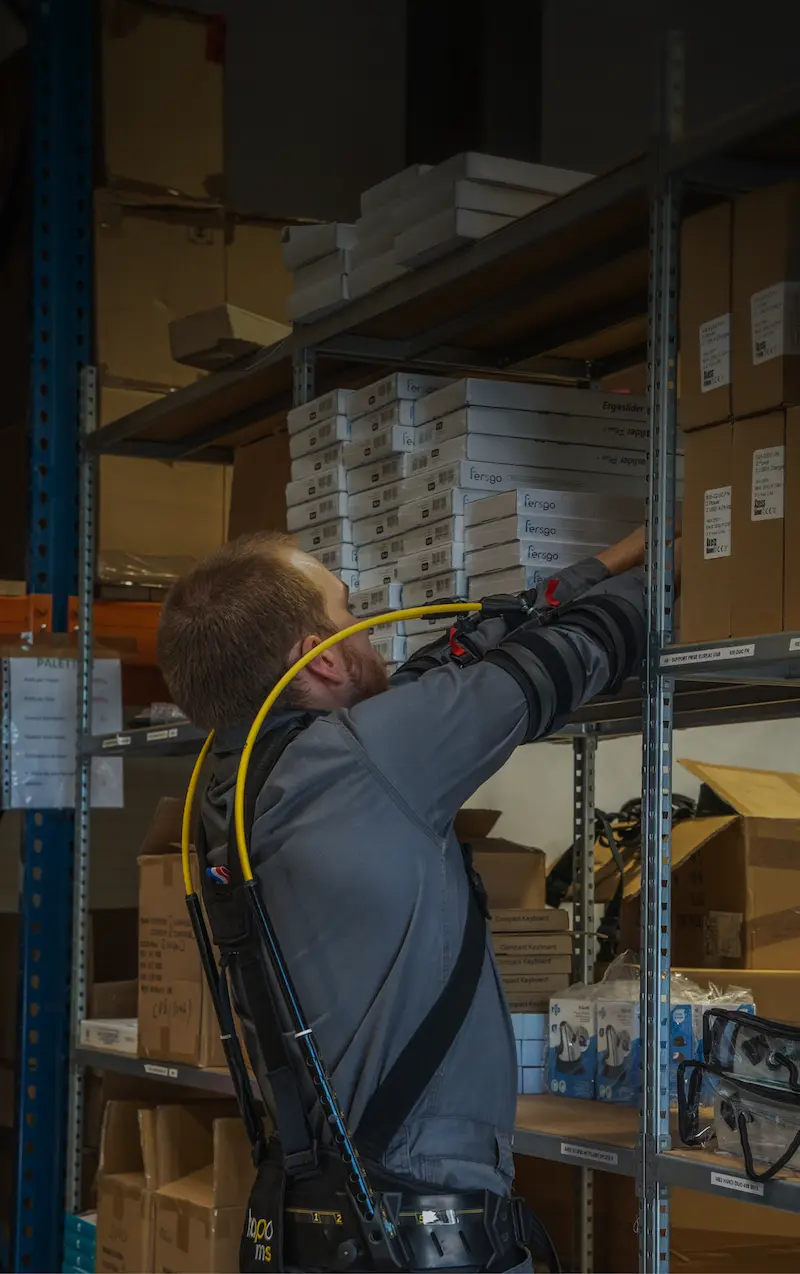
Hapo UP addresses another configuration: tasks performed with arms raised.
In handling or logistics, this situation can particularly occur during operations carried out at height. The device then supports the shoulders and arms to reduce fatigue.
You can also consult our guide dedicated to exoskeletons in logistics and warehousing to consider tasks encountered in these environments.
Hapo NECK relieves the neck during "head-up" work. This strain is present when storing packages or pallets at height, for example.
Musculoskeletal disorders can affect muscles, tendons, nerves, and joints. In the professional context, several biomechanical factors can contribute to their occurrence, including:
the repetitiveness of movements - exertion - handling - awkward postures - prolonged maintenance of a posture - trunk flexions - working with arms raised.
In response to these factors, the exoskeleton should not be considered as an isolated solution.
A prevention approach primarily seeks to understand the real situation:
why does the operator need to bend over?
Can the height of the task be adjusted?
Can manual handling be avoided?
Can the workstation be modified?
Is a collective technical aid possible?
Can the organization of work be adapted?
The INRS broadly reminds us that the prevention of occupational risks should prioritize reducing risks at the source.
The exoskeleton can then be considered among the solutions studied when a residual constraint remains and individual physical assistance is relevant.
It does not replace:

. support a targeted body area
. assist certain movements
. reduce certain biomechanical demands
. limit fatigue associated with certain tasks
. contribute to the prevention of risk factors for MSDs (Musculoskeletal Disorders)
. heals a musculoskeletal disorder
. eliminates all risks
. prevents any injury
. allows carrying heavier loads
. replaces workstation ergonomics
The choice begins in the field, not in a catalog.
Before selecting a model, it is necessary to closely observe the task and the constraints the user is facing.
The analysis must specifically identify:
A postural analysis can help to objectify this step. HAPO is specifically developing HAPO LEA, a postural analysis application based on artificial intelligence and relying on the RULA method to assess postural risks associated with MSDs.


Once the constraints are identified, it becomes possible to seek the corresponding type of assistance.
Some examples:
This approach avoids a common mistake: choosing an exoskeleton solely because it is presented as suitable for handling.
Theoretically relevant assistance can become ineffective if it hinders the essential movements required for the activity.
The test must therefore take into account:
freedom of movement
comfort
At HAPO, devices are evaluated in the laboratory, particularly through biomechanical measurements, but also in real working conditions. Objective data is complemented by user feedback.

Price should not be the only selection criterion. The analysis should also include the reduction of work stoppages, performance reservation, employee well-being and satisfaction (reduced turnover and better attractiveness for future hires).
Discover in this article the good reasons to invest in a Hapo exoskeleton.
The successful integration of an exoskeleton relies on a gradual approach. Imposing equipment without prior analysis or user involvement risks compromising its adoption.
1 Step 1: Start from the actual task
The observation must be carried out under representative working conditions. Movements, frequencies, postures, and environmental constraints are identified before selecting a solution.
2 Step 2: Select targeted support
The device is chosen according to the area requested and the type of movement. This step helps to eliminate solutions that do not meet the identified biomechanical need.
3 Step 3: Conduct a real-world trial
The test allows for the verification of several essential dimensions: perceived effectiveness, comfort, freedom of movement, compatibility with the task, compatibility with the work environment, acceptability, and the absence of new constraints.
A trial may also reveal that a device initially considered is ultimately not suitable. This is precisely the purpose of this phase.
4 Step 4: Adjust, Train, and Support
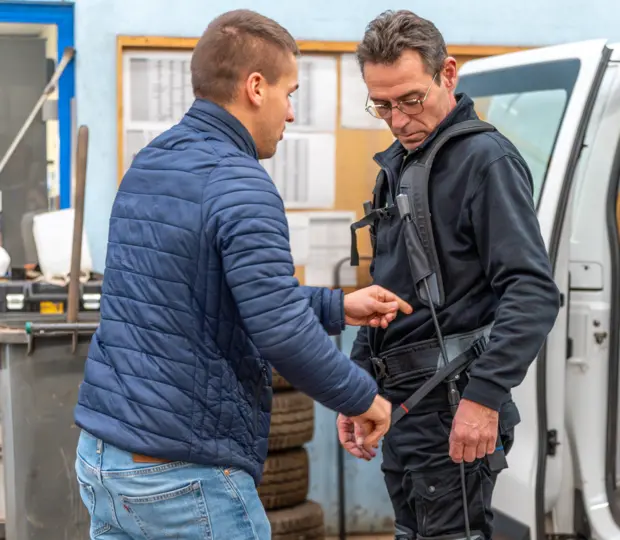
After selection, the user must learn to set up and properly adjust their equipment.
The support includes appropriate adjustments for the user, learning how to use it, and monitoring feedback from the field.
5 Step 5: Reevaluate Over Time
A position evolves. The pace, products handled, tools, organizations, or tasks may change.
The integration of an exoskeleton must therefore be part of a monitoring logic: gather user feedback and reassess the relevance of the device when the work situation evolves.
Since 2016, HAPO, a brand of ErgoSanté, has been designing and manufacturing non-motorized exoskeletons intended to assist professionals facing repetitive movements and demanding postures.
HAPO acts as a designer, manufacturer, and integrator. Its approach is not limited to the device itself: it combines research and development, biomechanics, ergonomics, testing, job analysis, and deployment support.
The HAPO range covers several body areas — back, shoulders, arms, and neck — to target different constraints. For handling, this diversity allows for the distinction of:
This approach avoids searching for a "universal" model and places the task at the center of the choice.

HAPO claims a French design and manufacturing process and relies on a multidisciplinary team that includes engineers, doctors in biomechanics, ergonomists, designers, analysts, integrators, and technicians.
This organization reflects the brand's positioning: putting technological innovation at the service of humans, with particular attention to lightness, simplicity, comfort, robustness, and freedom of movement.
HAPO devices are evaluated in the laboratory and under real working conditions. According to the evaluations, the analysis may focus on:
The objective remains the same: not to select a solution based on a simple intuition, but to verify its suitability with the work situation.
A handling exoskeleton can help reduce certain biomechanical constraints and the fatigue associated with demanding tasks. However, its effectiveness depends on one essential condition: selecting the assistance based on the actual work situation.
Bending of the torso, leaning posture, working in a low position, repetitive arm movements in front of oneself, or working with arms raised require different responses.
The exoskeleton should also remain a component of a comprehensive prevention approach: it neither replaces risk reduction at the source, nor the ergonomics of the workstation, nor the organization of work.
HAPO supports companies in analyzing the need, choosing the solution, testing it, and integrating it.
Consult with a HAPO expert and test a solution adapted to your situation
There is no absolute best handling exoskeleton. The device must match the task, movements, postures, and the body area being used. An analysis of the job followed by a trial under real conditions helps identify the most relevant solution.
No. The goal of a professional exoskeleton is not to increase handling limits or to allow for carrying heavier loads. It aims to reduce certain physical demands associated with an identified task and should remain part of a comprehensive prevention approach.
The choice depends on how the back is being used. Repeated bending, maintaining a bent trunk, working in a crouched position, and the need for freedom of movement correspond to different situations. HAPO offers several solutions for the back; a task analysis helps guide the choice.
This depends on the technology. HAPO exoskeletons are passive or non-motorized devices: they do not require a battery to recharge. Depending on the models, their mechanisms store and release mechanical energy to provide targeted assistance to movement or posture.