Exoskeleton for carrying heavy loads: how to relieve strain on the back?

Exoskeleton for carrying heavy loads: how to relieve strain on the back?

The essential

  • A exoskeleton for carrying heavy loads can relieve some strain on the back during bending, straightening, and maintaining awkward postures.
  • According to INRS, lower back pain accounts for 20% of workplace accidents, and nearly half of these back-related accidents occur during lifting.
  • The weight of a load is not the only risk factor: its position, the frequency of handling, and the adopted postures also influence the efforts.
  • The Hapo BACK, HD, SD, BR, and CS exoskeletons provide different forms of lumbar assistance depending on the movements, professions, and body types.
  • An exoskeleton does not allow you to lift heavier loads: its goal is to reduce certain physical constraints, following an analysis of the workstation.

Lifting boxes, handling construction materials, or moving industrial parts: lifting loads puts daily strain on the backs of many professionals. When these operations are repeated or accompanied by awkward postures, they can lead to significant fatigue and increase the risk of musculoskeletal disorders.

An exoskeleton for lifting heavy loads can help alleviate these efforts by assisting certain body movements. However, not all devices meet the same needs. Discover how this assistance works, in which professions it can be relevant, and what solutions Hapo can consider based on your working conditions.

Lifting heavy loads: what risks for the back?

Low back pain, an important issue in occupational health

Carrying loads is a recognized risk factor for low back pain, a pain located in the lower back.

The INRS statistics illustrate the importance of this issue:

  • 20% of workplace accidents are related to low back pain.
  • Nearly half of workplace accidents related to low back pain occur during load carrying.

These data highlight the importance of reducing physical constraints related to handling, particularly in jobs where efforts are frequent.

Why do certain handling tasks put more strain on the back?

Lumbar constraints do not depend solely on the weight of the objects being transported.

Several factors can increase the demands:

  • Heavy or bulky loads.
  • Picking up loads from the ground.
  • Repeated bending and straightening movements.
  • Prolonged leaning of the torso.
  • Rotations of the torso with a load.
  • High cadences and limited recovery opportunities.

That is why two employees handling identical loads may be exposed to very different constraints depending on their workstation.

Why does the position of a load influence the strain on the back?

The principle of the lever, explained simply.

Imagine that you are carrying a 10 kg box close to your body, then you move it away by extending your arms.

The box retains exactly the same weight, but the effort required to hold it increases.

This phenomenon is explained by the principle of leverage: the further a load is from the body, the greater the torque it generates around the relevant joints.

The muscles then have to exert more effort to stabilize the body and control the movement.

In handling, this explains why retrieving an object from the bottom of a bin or a pallet can be particularly taxing on the back.

The height and frequency of the manipulations also matter.

A load picked up from the ground generally requires bending of the trunk, hips, or knees. When this action is repeated several dozen times, the muscular demands can accumulate.

Rotations and asymmetrical postures are also factors to consider.

These parameters are notably taken into account by the international ergonomic method Revised NIOSH Lifting Equation, used to evaluate certain manual lifting operations.

The challenge is therefore to reduce the efforts related to repetitive movements and constrained postures, and not just to consider the weight of the load.

How can an exoskeleton relieve the back during load carrying?

A mechanical assistance that accompanies movements.

A lumbar exoskeleton is a device worn on the body to assist with certain postures or movements.

Passive exoskeletons Hapo operate without a motor or battery. Depending on the models, their mechanisms use elastic resistance properties to store and then release mechanical energy.

When an operator bends to lift a load, some devices can provide assistance during the bending or straightening of the torso.

This assistance can help to:

  • Reduce certain muscular strains on the back.
  • Limit fatigue associated with repeated bending.
  • Assist with straightening after lifting a load.
  • Provide lumbar support during certain prolonged postures.

Relieve efforts without increasing loads.

An exoskeleton does not lift the load instead of the worker. It can modify the distribution of certain efforts, but it does not eliminate the constraints placed on the body.

Its effectiveness depends on the task, the assistance mechanism, and the adaptation of the device to the user.

The goal is therefore not to enable carrying heavier objects, but to reduce certain stresses during demanding operations.

Which exoskeleton Hapo to choose based on your profession and your movements?

The needs for physical assistance vary depending on the professions, but also according to the tasks performed on a daily basis.

A warehouse worker who regularly lifts boxes from the ground does not face the same constraints as an industrial operator who works for several hours with their torso bent or a tiler who alternates between squatting and working on their knees.

That is why the choice of an exoskeleton for lifting heavy loads should primarily depend on the movements, postures, and body areas involved, and not solely on the job title.

Hapo offers several passive exoskeletons designed to support the back, with forms of assistance tailored to different professional situations.

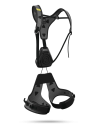
Comparison of Hapo exoskeletons according to professions and needs

Exoskeleton ModelExamples of Relevant ProfessionsWork Situations to EvaluateDesired Benefits
Hapo BACKMaterial handler, warehouse worker, production operator, winemakerLifting loads with torso bending, working bent over, and prolonged posturesSupport the lower back, assist with bending, and limit back fatigue
Hapo HDOrder preparer, material handler, industrial operatorRepetitive lifting, picking loads from the ground, frequent bending and straightening movementsAssist with straightening the torso, improve posture, and reduce certain muscle strains
Hapo SDTiler, mason, landscaper, warehouse workerHandling in low positions, working squatting or kneeling, frequent posture changesProvide lumbar support in various positions and limit fatigue
Hapo BRIndustrial operator, warehouse worker, healthcare professionalActivities requiring lumbar relief with a high degree of freedom of movementContribute to lumbar comfort through passive assistance via vertical traction
Hapo CSOrder preparer, production operator, caregiver, farmerRepeated trunk bending, handling, and constrained postures requiring adaptation to female morphologyProvide lumbar support adapted to female morphology and promote comfort

These examples of professions are indicative. The same professional may perform very different tasks depending on their environment. The suitability of an exoskeleton must always be confirmed by an ergonomic analysis and a trial in a real situation.

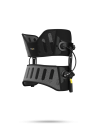
Hapo BACK : support the back during handling and bent postures

Hapo BACK is a passive exoskeleton designed for lumbar support.

It can be particularly beneficial for a manual worker, a warehouse worker, or a production operator who regularly works with their torso inclined forward.

In a warehouse, for example, an employee who retrieves packages from the lower levels of shelving may need to maintain bent postures or repeat bending movements.

The assistance of the Hapo BACK aims to relieve certain lumbar stresses and reduce fatigue associated with these movements.

It can also be studied in agricultural activities requiring prolonged inclined postures.

Hapo HD: supporting repeated bends and straightening

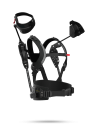
Hapo HD integrates an artificial muscle designed to assist with the bending and straightening movements of the torso.

It serves as an evaluation tool for professions where these movements are particularly frequent.

This is especially true for a warehouse worker who regularly picks up boxes from the ground to place them on a pallet, or for an industrial operator who bends down to feed a machine.

Its assistance aims to support the movement of the back and reduce certain muscular strains during the bending and straightening phases.

Hapo SD : a lumbar support for professions working close to the ground

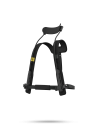
Hapo SD is designed to support the back in various working positions, particularly during dynamic tasks performed in a low position.

It can be beneficial for tilers, masons, or landscapers who alternate between standing, crouching, and kneeling positions.

In certain storage or handling operations, warehouse workers may also need to retrieve items from low heights.

The Hapo SD aims to provide lumbar support in these varied postures while accommodating changes in position.

Hapo BR: prioritize lumbar comfort and freedom of movement

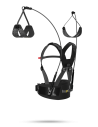
Hapo BR stands out for its passive antigravity system based on vertical traction assistance.

It aims to reduce certain biomechanical constraints at the lumbar level while preserving a great freedom of movement.

It can be considered for various professional activities, particularly in industry, logistics, or healthcare, when the job analysis identifies a specific need for lumbar comfort.

Its mechanism differs from that of exoskeletons primarily designed for repeated bending. Its usefulness should therefore be evaluated based on the actual constraints encountered.

Hapo CS : a lumbar support adapted to the female morphology

Hapo CS is a lumbar support exoskeleton specifically designed to take into account the female morphology, particularly pectoral comfort.

It can be studied for production operators, order preparers, or healthcare professionals exposed to repeated bending and constrained postures.

In certain handling activities, it aims to support the back while promoting an adjustment suited to the user's morphology.

As with all devices, comfort and freedom of movement must be verified during a trial.

The right exoskeleton primarily depends on your work situation.

These examples show that there is no universal exoskeleton for all jobs involving load-bearing.

The same position may involve lifting, transporting, maintaining posture, or working in a low position. Each situation places different demands on the body.

The goal is therefore to identify the movements that generate the most strain in order to select a truly suitable assistance.

To discover the characteristics of the different models, check out the HAPO exoskeleton range.

How to verify that an exoskeleton will truly be suitable for your job?

Step 1: Identify the most restrictive gestures

Before selecting a model, it is necessary to observe the tasks performed.

The analysis should particularly focus on:

  • The bending and straightening movements.
  • The frequency and duration of handling.
  • The maintained postures.
  • The heights of lifting and placing.
  • The movements and rotations.
  • The body areas most affected.

This step allows for determining the type of assistance to seek.

Step 2: test the device in real conditions

An exoskeleton may seem comfortable during a demonstration, but its benefits must be confirmed during regular operations.

The trial allows for the evaluation of:

  • The relief felt in the back.
  • The comfort and freedom of movement.
  • The ease of setup.
  • The compatibility with tools and equipment.
  • The absence of new constraints.
  • The acceptability by the user.

Hapo offers support in analyzing positions, selecting devices, and their integration.

The brand also develops tools like Hapo LEA, an AI-assisted mobile application designed for analyzing postural risks.

Step 3: Integrate the exoskeleton into a prevention approach

An exoskeleton does not replace the improvement of the workstation.

Before considering its use, it is important to study the possibilities of reducing the weight of loads, improving storage heights, or using mechanical aids.

Physical assistance then serves as a complementary solution for certain residual constraints.

It should never lead to an increase in the handled loads or impose higher rates.

Conclusion: which exoskeleton to relieve the back when carrying loads?

Carrying heavy loads can expose professionals to significant strain on the back, especially when handling tasks are repetitive or associated with awkward postures.

A passive exoskeleton can help reduce some of these constraints by assisting movements or providing targeted lumbar support.

The choice primarily depends on the actions performed: prolonged bending, repeated straightening, working in a low position, or specific needs for lumbar comfort.

With its range of non-motorized exoskeletons designed and manufactured in France, Hapo supports companies in identifying and evaluating suitable assistance solutions for their work situations.

Do you want to know which exoskeleton would be most relevant for your handling operations? Check out our article on the handling exoskeleton.

FAQ — Exoskeleton and Heavy Load Carrying

Which exoskeleton to choose for a handler?

The choice depends on the movements performed. For repeated bending and straightening, the Hapo HD can be considered. The Hapo BACK is suitable for tasks involving prolonged bending, while the Hapo SD may be relevant for low lifts. A trial allows for confirming the suitability of the device.

Can an exoskeleton lift a load of 30 kg?

An exoskeleton should not be seen as a permission to lift 30 kg. It can reduce certain muscular strains, but does not eliminate physical constraints. Lifting limits remain determined by working conditions, ergonomic assessment, and applicable regulations.

Can an exoskeleton reduce back fatigue at work?

Yes, a suitable device can help limit fatigue related to certain bends, sustained postures, or repetitive operations. However, the benefit depends on the type of assistance and the movements performed. A trial in real conditions is necessary to assess the comfort and relief experienced.

Can an exoskeleton be used to carry loads all day?

The duration of use should be adapted to the model, the tasks, and the user. Permanent use of an exoskeleton is not systematically necessary or relevant. An analysis of the position, trials, and monitoring help determine the periods when assistance provides real benefits.