Do postural support devices weaken the muscles?

Do postural support devices weaken the muscles?

Assistance devices (such as lumbar belts or non-motorized exoskeletons) are widely used, both in the medical field and in certain professional contexts, to relieve the back and reduce mechanical strain. However, a long-standing question remains: could their use lead to a weakening of the trunk muscles, or even muscle atrophy?

This question has been the subject of a thorough scientific analysis - Azadinia et al. (2017), which provided clear answers.

A concern based on a simple... but debatable idea

The often-cited argument is as follows: by supporting the back, a lumbar belt would reduce the work of the muscles, which could, in the long term, make them weaker. This concern is based on an analogy with well-known situations, such as immobilization with a cast, which indeed causes muscle loss.

But this comparison deserves to be nuanced. A lumbar belt does not restrict movement: it accompanies the motion, limits certain excessive ranges, but allows the body to function.

A systematic review to take stock

To answer this question, researchers conducted a systematic review of the scientific literature, analyzing 35 studies on the effects of lumbar belts (lumbosacral orthoses) on trunk muscles.

The studies examined focused on different indicators:

  • the activity of back and abdominal muscles during exertion,
  • muscle strength and endurance,
  • the load exerted on the spine,
  • the very structure of the muscles (thickness or cross-section).

This is one of the most comprehensive analyses available on the subject.

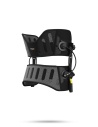
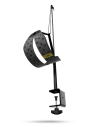
Exoskeleton Hapo BR

Muscle activity: variable results, but not alarming

Some studies show a moderate decrease in muscle activity when wearing a lumbar belt, especially during lifting tasks or maintaining posture. Other studies, however, show no change, or sometimes even an increase in the activity of certain muscles.

These variations can be explained by numerous factors:

  • the type of belt used (flexible, elastic, non-stretchable),
  • the task performed (lifting, sitting, standing),
  • the posture and speed of movement.

An important point emerges nonetheless: the observed decreases are slight and contextual, and do not correspond to a prolonged rest of the muscles.

There is therefore no scientifically proven consensus on the impact of wearing lumbar belts in terms of muscle activity.

Strength and endurance: no demonstrated loss

When considering the most significant criteria for evaluating potential muscle weakening — strength and endurance — the results are particularly reassuring.

The majority of studies:

  • show no decrease in muscle strength,
  • do not indicate any loss of endurance,
  • and, in some cases, even observe improvements.

These results are observed after both short and longer periods of wearing a lumbar belt.

The issue of muscle atrophy

Muscle wasting corresponds to a decrease in the size and structure of muscles. However, among the 35 studies analyzed, only one suggests a reduction in the thickness of certain trunk muscles.

The authors note, however, that this result is isolated and difficult to interpret, especially since muscle wasting is classically associated with complete immobilization of a joint — which is not the case with a lumbar belt, which does not eliminate movement, but merely guides or limits it.

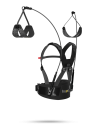
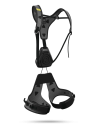
Hapo SD

The scientific conclusion is clear.

After analyzing all available data, the authors of the review conclude that there is no conclusive scientific evidence showing that wearing lumbar belts leads to trunk muscle weakness.

In other words:

  • the muscles continue to function,
  • their structure is not permanently altered,
  • and the hypothesis of generalized weakening is not supported by current scientific data.

And what about passive exoskeletons?

It is in light of these results that we can reasonably broaden the reflection.

If lumbar belts, which can partially restrict certain movements, do not lead to muscle wasting, then it is logical to consider that passive exoskeletons, which preserve mobility even more, present the same profile a fortiori.

Passive exoskeletons:

  • do not immobilize the body,
  • and allow the user freedom of movement.

They therefore fully align with the continuity of the passive devices studied, without constraining the muscles.

In summary

The available scientific data shows that passive back support, when it does not prevent movement, does not lead to muscle loss.

In this logic, passive exoskeletons, which are precisely based on the principle of assistance without immobilization, do not present a specific risk of muscle wasting according to current knowledge.

Contact one of our experts

Our teams are at your disposal to assess your needs and organize real-life tests to allow your employees to experience the benefits of exoskeletons in their work environment.

Contact one of our experts

Our teams are at your disposal to assess your needs and organize real-life tests to allow your employees to experience the benefits of Hapo exoskeletons in their work environment.